
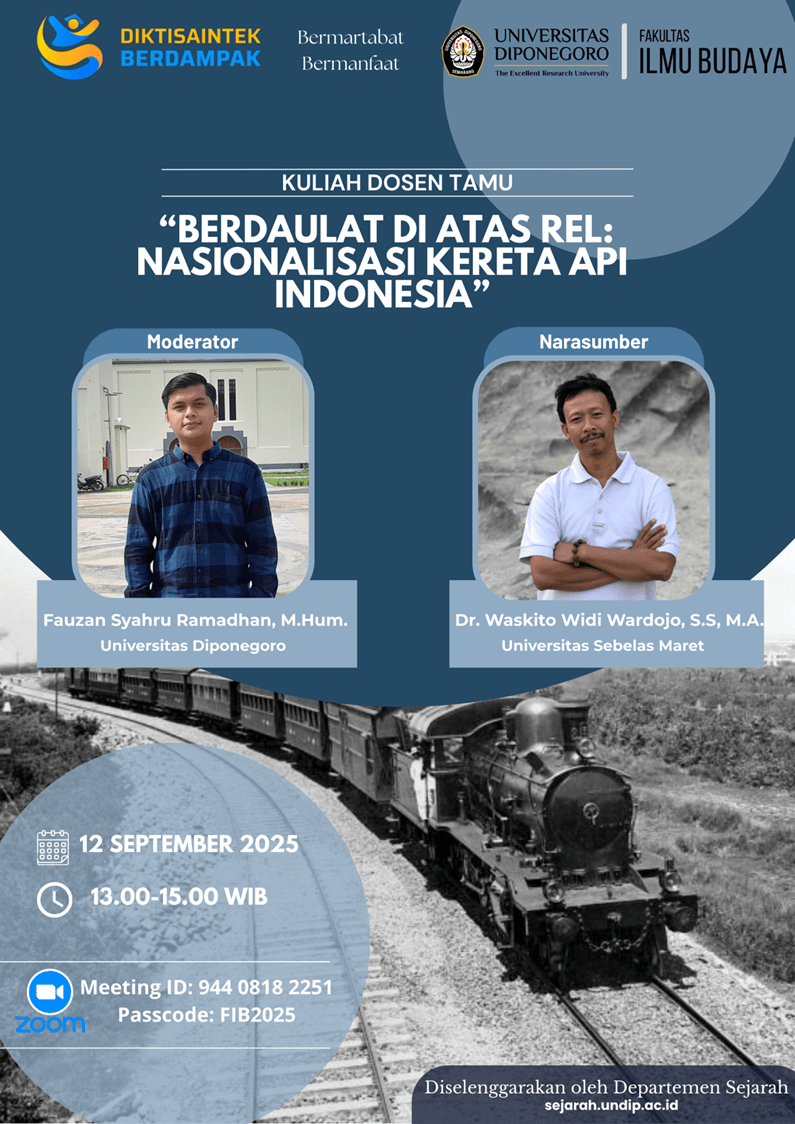
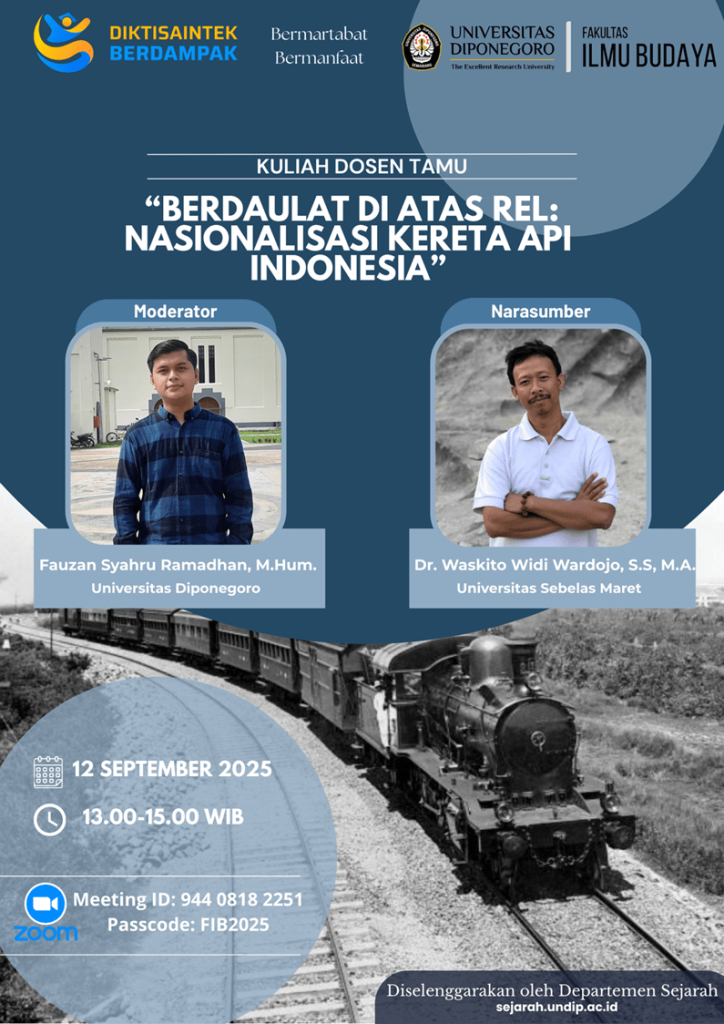
Semarang, September 12, 2025 – The History Department, Faculty of Cultural Sciences, Diponegoro University, successfully held a Guest Lecture titled “Sovereign on the Rails: The Nationalization of Indonesian Railways.” The event took place virtually via the Zoom teleconference platform on Friday, September 12, 2025, from 1:00 to 3:00 PM WIB. The primary aim of this Guest Lecture was to provide students and the general public with an in-depth understanding of the meaning, process, and challenges of nationalizing the railway companies.
The activity was opened by the Dean of the Faculty of Cultural Sciences, Diponegoro University, Prof. Dr. Alamsyah, M.Hum., who warmly welcomed this initiative by the History Department. The speaker for this event was Dr. Waskito Widi Wardojo, S.S, M.A., Head of the History Study Program at FIB UNS and a Ph.D. alumnus of FIB Undip’s History Department. The event was hosted by Keke Pahlevi Daradjati, S.Pd., M.A., and moderated by Fauzan Syahru Ramadhan, M.Hum.
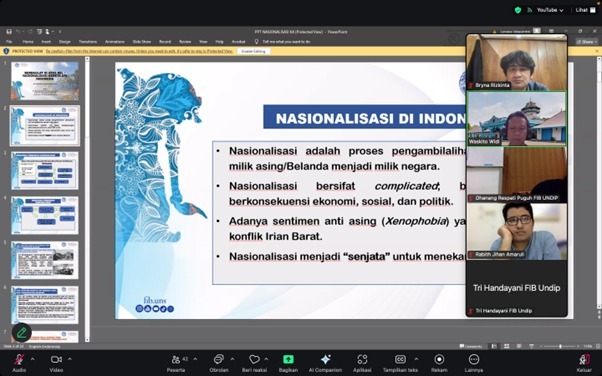
During the two-hour session, Dr. Waskito Widi Wardojo, S.S, M.A. explained the process and tensions involved in the nationalization of railways in Indonesia. In his presentation, he described that railway nationalization occurred in two phases. The first phase targeted state railway companies (owned by the Dutch), namely Staatspoorwegen, based on the Renville Agreement. The second phase involved 11 private Dutch railway companies in accordance with Law No. 86 of 1958. In the historical context of the time, nationalization was part of the strategy to pressure the Dutch during the struggle for West Irian. However, not all parties agreed on nationalization. Criticism came from some circles due to the government’s lack of preparedness regarding funding sources and the limited attention to local resources.
Despite these criticisms and recognizing that the Dutch private railway companies were operating at a loss, the nationalization process continued, as it was a matter of national pride and identity for a sovereign nation. Finally, on September 7, 1966, negotiations were held for compensation related to the nationalization of all Dutch private companies. The negotiations produced a payment installment scheme over 30 years (1973–2002), which represented a diplomatic victory for Indonesia and a defeat for Dutch diplomacy.
After the presentation, there was an engaging and dynamic discussion session, featuring interesting questions from participants. Those who put forward questions included Dra. Tri Handayani, M.Si., followed by Dr. Rabith Jihan Amaruli, M.Hum., Prof. Dr. Drs. Dhanang Respati Puguh, M.Hum., Ahmad Fauzan Baihaqi, M.Hum., and Johanes Baptisa Handaru.
At the end of the webinar, Dr. Waskito also provided insights on areas within the study of railway history that still offer research opportunities, potentially serving as topics for thesis research.
