
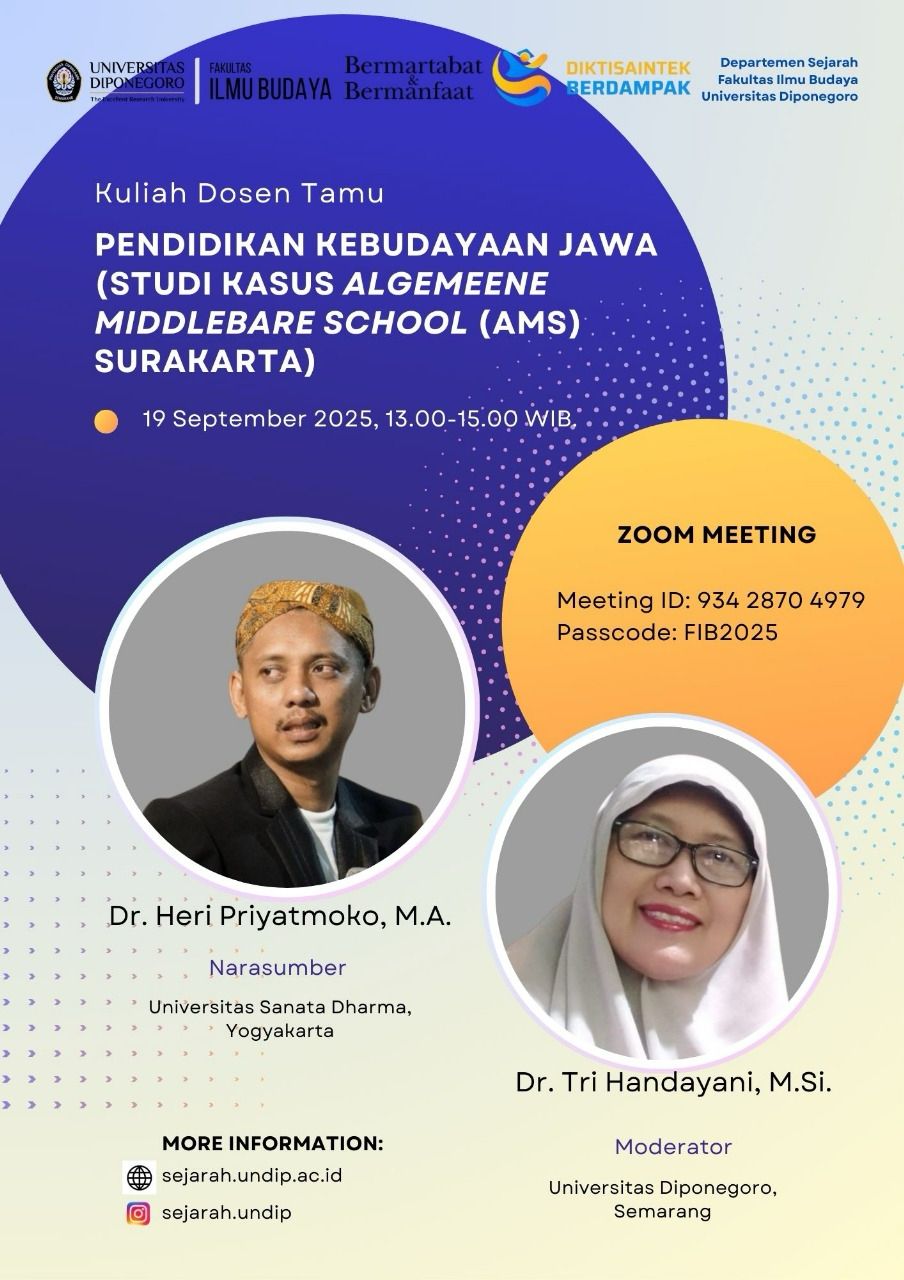
Semarang, September 19, 2025 – The Department of History, Faculty of Humanities, Diponegoro University (FIB UNDIP), successfully held a guest lecture titled “Javanese Cultural Education: A Case Study of Algemeene Middlebare School (AMS) Surakarta”, which was conducted online via the Zoom digital platform. The guest lecture was officially opened by Prof. Dr. Dhanang Respati Puguh, M.Hum., as the Head of the History Department at FIB UNDIP. In his remarks, Prof. Dr. Dhanang Respati Puguh, M.Hum., stated that UNDIP regularly organizes activities such as this to enhance the academic performance of its academic community.
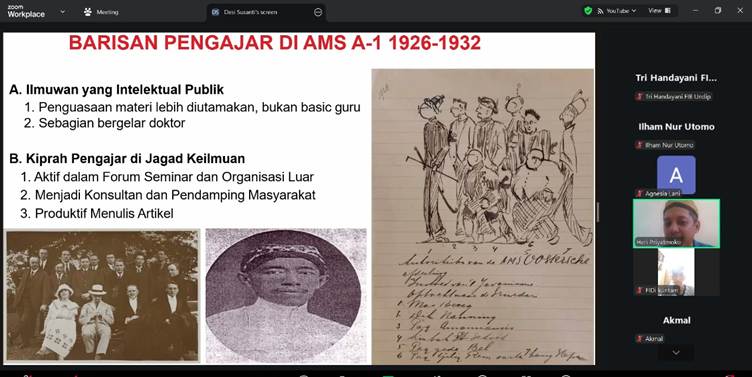
The speaker for the event was Dr. Heri Priyatmoko, M.A., with Dr. Tri Handayani, M.Si., serving as the moderator. Dr. Heri Priyatmoko, M.A., presented material on the dynamics of Algemeene Middlebare School (AMS) Surakarta as an institution focused on Javanese cultural education from 1926 to 1932. According to him, although AMS existed for only a relatively short time, it made significant contributions to the development of Javanese cultural knowledge and the spirit of nationalism.
Most of its alumni became part of the “golden generation,” with significant careers and influence. Examples include Mr. Hindromartono (Minister of State for Police Affairs, member of BPUPKI), Mr. Rastian Rassad (translator of legal texts, teacher at Tjideng Timur 73 Jakarta High School), B.R.M. Jartobitoe (son of HB VIII and palace official in the field of culture), and Dr. Wirjono Prodjodikoro (Chief Justice of the Supreme Court, author of law literature).
In addition to presenting material on AMS’s movement as an educational institution during the Dutch colonial era, Dr. Heri Priyatmoko, M.A., also highlighted research opportunities available to participants of the guest lecture who are interested in studying the prominent figures that emerged from an AMS education.
The discussion session was then opened following the completion of the presentation, with participants’ questions answered by the speaker.
