
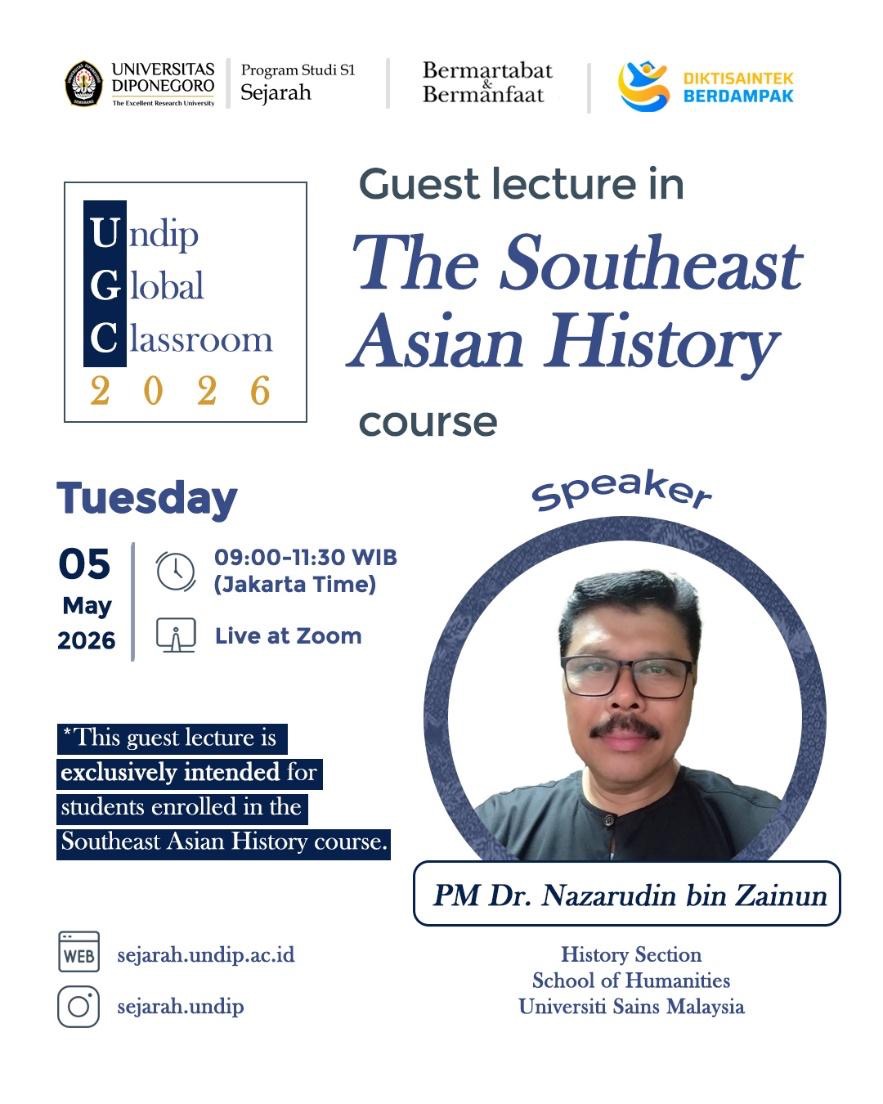
As part of the Undip Global Classroom 2026 (UGC 2026) program, the Undergraduate Program of History of the Faculty of Humanities, Universitas Diponegoro, was holding an international guest lecture in the Southeast Asian History course. The lecture was held on Tuesday, May 5, 2026, from 09.00–11.30 WIB via Zoom. PM Dr. Nazarudin bin Zainun from the History Section, School of Humanities, Universiti Sains Malaysia, served as the guest speaker at the lecture; he presented case study of the development of Hinduism and Buddhism in Kedah Tua, Malaysia. This activity was specifically intended for students of the Southeast Asian History course as an effort to enrich cross-national academic perspectives and simultaneously support the internationalization of the curriculum.
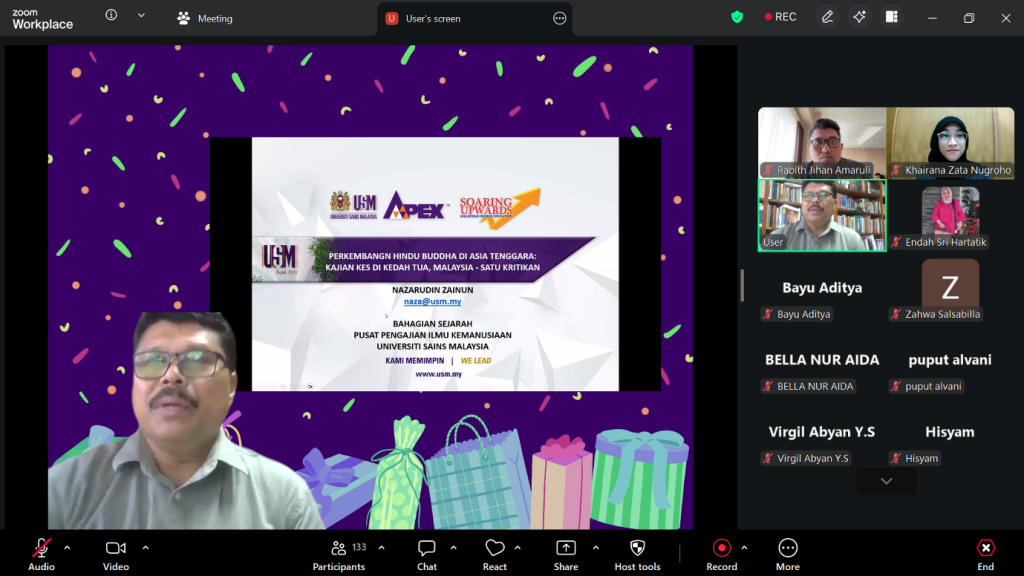
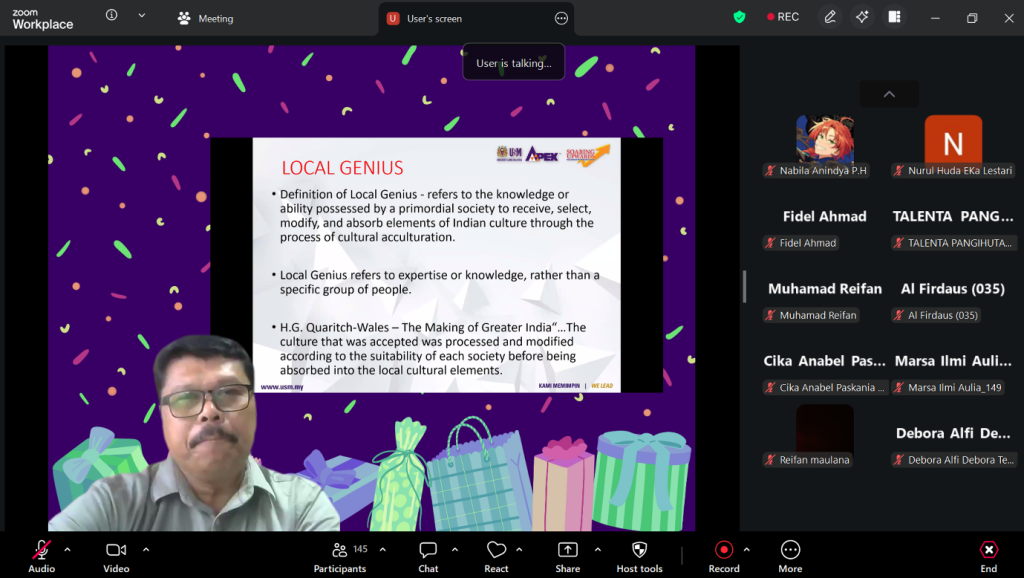
In his presentation, Dr. Nazarudin discussed the dynamics of the spread of Indian influence in Southeast Asia, offering a critique of the conventional “Indianization” theory. He emphasized the importance of understanding that the process occurring in Kedah Tua was not a direct imitation or cultural colonization, but rather an “active” process in which local communities played an active role in selecting and adapting foreign cultural elements. He also highlighted how historical narratives are often dominated by a Western-centric perspective, such as the four-wave theory of Indian influence by H.G. Quaritch-Wales, which tends to overlook the agency or capability of local societies. Therefore, he encouraged students to explore the concept of Local Genius as a basis for examining how Indian elements were adapted, such as in the use of local materials (wood and nipah) in temple architecture and the absence of Sanskrit language usage in the inscriptions of Kedah Tua.
The discussion also addressed methodological differences in interpreting archaeological evidence, including the discovery of beads that were proven to be locally produced rather than imported goods. Dr. Nazarudin emphasized that the Hindu-Buddhist heritage in Kedah Tua was the result of hybrid assimilation and cultural interaction, so the history of this region should not be understood merely as a shadow of Indian culture, but rather as a form of creative adaptation by the local community. This guest lecture provided a valuable opportunity for students to engage directly with international scholars and broaden their horizons in understanding the region’s history. This activity stands as evidence of the commitment of the Undergraduate Program of History at Universitas Diponegoro to building international academic networks and preparing graduates who possess global perspectives and sensitivity to regional historical diversity.
